
How Does The Grading System Work?
Australian Shotokan Karate Jutsu (ASKJ) has a grading system designed to allow students to proceed through levels, or grades demonstrating their personal growth and development in their chosen Martial Art.
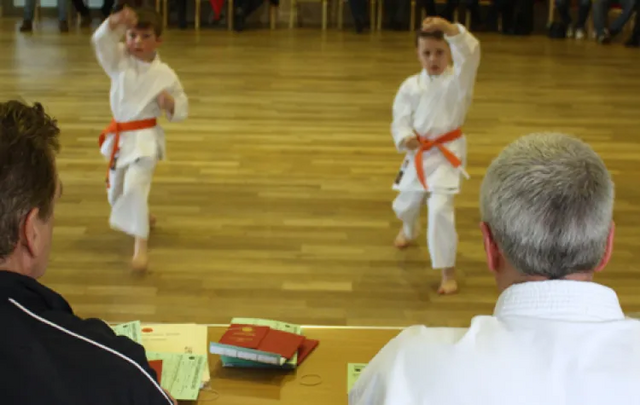
Most students and parents like to measure their progress as they slowly master their basic techniques that prepare them for more advanced learning.
Our Karate Grading System
What Does A Grading Mean? In our School we use a triple A method. The first “A” signifying that you have met the attendance criteria, viz, you have to attend a certain number of classes.
The second “A” demonstrates that you have the ability to complete the grading from our syllabus understanding that some may be more able than others due to a number of factors.
The third “A” signifies that you have displayed the correct attitude at home, in the Dojo and at school.
Coloured belts are like stepping-stones on the path to your goal of Black belt. A belt awarded represents that a student has reached a competent level with their current techniques and are ready to move on to learn and develop more advanced techniques and skill-sets.
What Is Involved? When a student has completed their minimum time period and lessons on a particular belt, and their Instructor believes they have gained a strong grasp of the technical requirements for their new grade, the instructor will invite them to grade at the next grading held in-house with approximately three weeks notice given. Gradings are generally held on a Saturday afternoon.. If a student has commitments and is unable to attend the grading, they can be looked at over the next few weeks and pass a Dojo Grading.
GRADING INFORMATION
Factors That Determine How Fast A Student May Grade are:
- The student’s frequency of training: Training more frequently means a student is getting to more classes in the time frame, but less time between training means muscle memory (technical habits and mastery) is developed far sooner and is why we recommend training at least 2 classes per week.
- Frequency of training: This also includes practising at home and additional advanced classes such as our Competition Elite or our Sempai Leadership classes.
- Training Intensity: Getting to classes is just one part of the equation. Once there, the student also needs to push themselves physically and constantly pushing their comfort zone producing faster, stronger and snappier technique as they progress through the grades.
- Focus: Karate is a mind and body pursuit. Focusing on technique develops correct technical habits, it also prevents bad habits from slipping in. Students who develop good focus generally carry this on in everyday life and school.
- Commitment: The karate journey is a personal one. Each of us develops in our ability and/or understanding at a different rate. When it comes to gradings, while there is a syllabus students must learn and develop in, ultimately each person is graded, or held back from grading, based on their own progress according to their own ability
- Personal development: It does not matter what others are doing, what matters is that the student is making progress. Your instructor is looking for you to be your best!
- Goal Setting: Working with your Instructor and communicating difficulties or what it is that you are currently aiming for will allow their instructor knows what to know what to expect of them and how much they can push them. ASKJ supports goal setting and part of goal setting is receiving feedback to help you towards your goals.
- Grading Misconceptions: Throughout your karate journey you will inevitably see some students grade ahead of you, and while this is sometimes obvious and justified, there may also be times where many student or parents feel and display frustration or anger over this - largely because they do not believe another student should be grading ahead of them. This demonstrates an ignorance towards grading.
Perhaps you make more technical errors. • You may be technically cleaner than the person grading, but perhaps your attitude is holding you back. Perhaps you have trained longer than the other person but your training ethic is poor. If you are training in karate to become the best you can be, then be happy training regardless of what belt you are.
Enjoy the journey and karate becomes a way of life.